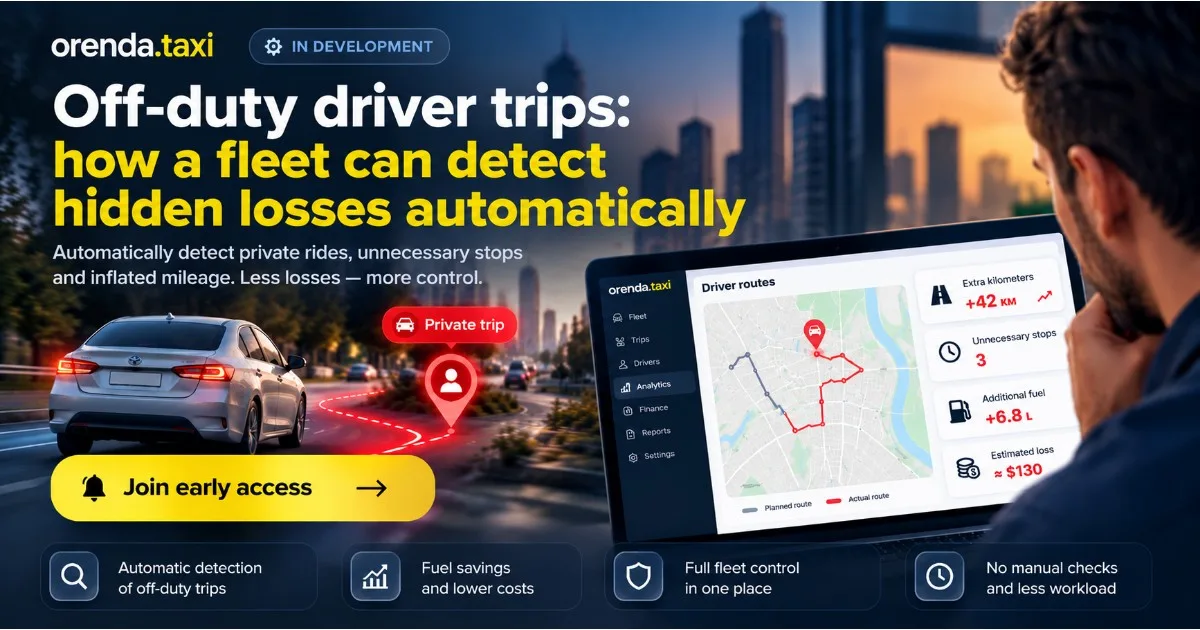
Off-app rides: how a taxi fleet can spot the losses without manual checks
A driver switches off the app and takes a passenger for cash, while the mileage, fuel and wear stay on the fleet. How to spot it by hand today — and how it can be automated.
In a fleet with hired drivers there is a loss almost nobody counts: rides that bypass the app. A driver switches off Bolt or Uklon, takes a passenger for cash — and the money never reaches your revenue, while the mileage, fuel and wear stay on the fleet. It is unfair to the other drivers too: those who work honestly see others earning on the side with no consequences.
Why it is hard to spot
A car covers dozens of kilometres per shift, and orders are scattered across several apps. GPS shows that the car was moving — but not whether there was a passenger in an app at that moment. Reconciling the track with Bolt, Uber and Uklon reports for every driver by hand takes hours a fleet owner simply doesn't have.
Besides, not every kilometre without an order is a violation. Driving to a pickup, waiting for orders, lunch, the commute to and from the shift are a normal part of the job. The goal is not to count all "empty" mileage but to find trips that look like a paid ride yet have no matching order in any app.
What you can do today, by hand
1. Compare mileage with orders once a week. For each driver: GPS kilometres versus the total kilometres of orders in the ride-hailing reports. What's normal depends on the city and schedule, so compare each driver with their own past weeks and with the rest of the fleet. A sharp drop in the share of "paid" mileage is a signal to look closer.
2. Check whether the car moves while the driver is offline. Movement during a shift while the driver is offline in every app is the simplest sign, visible even without a detailed look at the track.
3. Spot-check the track. The typical signature of an off-app ride: a short 1–5 minute stop (pickup), a drive of a few kilometres and another short stop (drop-off) — not at home, not at lunch, and with no order at that time.
4. Put the rules in the contract. That the car is GPS-monitored, how trips are counted and what counts as a violation. A rule the driver knows in advance keeps discipline better than any check.
How it can be automated
Once the car's GPS track and the ride-hailing orders sit in one system, every kilometre of a shift sorts itself out:
- pickup — from the moment the driver accepts an order until the passenger gets in;
- ride — from pickup to drop-off;
- home — where the car usually parks overnight (as an area, not an exact address);
- lunch — a long daytime stop;
- to review — trips with a ride's signature but no matching order.
Instead of digging through tracks, the manager sees for every driver the share of mileage under orders, flagged trips on the map and a short plain-language explanation — and decides what to do about it.
Honest about the limits
This is an estimate, not a verdict: the system highlights trips, a person makes the call. It needs data from all the apps a driver works in: if one is missing, honest trips will look suspicious. And privacy: only the working shift should be analysed, and drivers must know about GPS monitoring.
We are building it — and looking for the first fleets
The module is in development in Orenda.taxi CRM, and we want to build it around fleets' real tasks, not guesswork. If you have hired drivers and this sounds familiar, join early access: a short questionnaire about your fleet, and you will be the first to see the prototype.
FAQ
How can I tell a driver is taking off-app rides?
The clearest signs are the car moving during a shift while the driver is offline in every app, and trips with short stops at the start and end with no order at that time. It also helps to compare GPS mileage with order kilometres every week.
Can I monitor a driver with GPS?
Only the working shift on the fleet's car should be analysed, and the driver must be told about GPS monitoring — the simplest way is a clause in the contract. It's best to have the wording checked by a lawyer.
What share of mileage under orders is normal?
It depends on the city, schedule and type of work, so there is no single number. It's more practical to compare a driver with their own previous weeks and with the fleet's other drivers: a sharp drop is a signal to look closer.