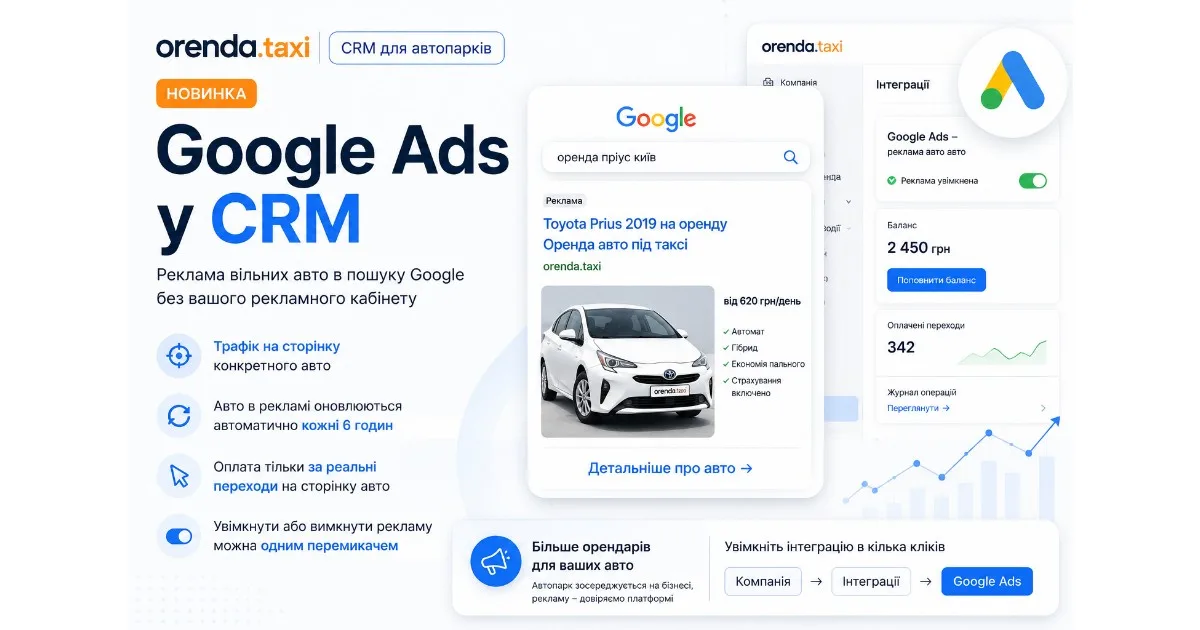
Google Ads in Orenda.taxi CRM: advertise available fleet cars automatically
Orenda.taxi now connects available fleet vehicles with Google Search. Ads lead prospects directly to the page of the specific car they searched for.
Orenda.taxi CRM now includes Google Ads integration for fleet advertising. The platform manages the Google Search campaign and promotes vehicles that are currently available for rent. Fleet owners do not need their own Google Ads account, separate campaign setup, Google budget management or a marketer to maintain the campaign.
The key difference is the destination. Ads do not send the user to a generic marketplace page. A person searching for a specific model can land directly on that vehicle page with photos, price and rental conditions.
Vehicle downtime is a direct business cost
Fleet size alone does not determine performance. A more useful metric is how many days per year each vehicle is actually earning.
When a car sits without a renter, revenue stops while leasing, insurance, parking, depreciation and other fixed costs may continue. Orenda.taxi CRM already tracks vehicle downtime. The new integration adds a way to expose an available car to people who are actively searching for car rental for taxi work.
An extra idle week in a four-week month removes roughly a quarter of that month’s potential rental time. For many fleets, filling an available vehicle faster matters more than simply adding more cars.
Be visible where drivers are already searching
Drivers use different channels. Some search Google, some browse a marketplace, others use Telegram groups, Facebook or Instagram. Relying on one channel means seeing only part of the demand.
Orenda.taxi already provides marketplace exposure, Telegram channels and social media distribution. Google Search adds a high-intent channel where a driver is already typing a query for a vehicle or a specific model.
In 2026, visibility itself is a competitive factor. A driver can compare several offers quickly and contact the one where the vehicle, price and rental terms are easiest to understand. A fleet may lose demand not because its cars are worse, but because the offer was not visible at the right moment.
How it works
- The owner or manager opens Company → Integrations → Google Ads — advertise your cars and switches the integration on.
- Orenda.taxi uses CRM availability data in the Google Search campaign.
- The advertised vehicle list refreshes automatically every 6 hours.
- A rented vehicle, a car in repair or a vehicle removed from publication stops being advertised automatically.
- When the car becomes available again, it can return to advertising without recreating the ad manually.
- The click goes directly to the specific vehicle page with its photos, price and conditions.
The fleet does not need to:
- create its own Google Ads account;
- manage a separate Google campaign budget;
- configure campaigns manually;
- hire a marketer just to maintain this advertising;
- manually disable an ad every time a car is rented.
Pay for actual visits, not impressions
The fleet pays only for real clicks to vehicle pages. Impressions are not charged.
Advertising uses a prepaid balance. The current fixed price per click is displayed in the CRM. When the balance reaches zero, advertising simply pauses. There is no debt, negative balance or automatic overspending beyond the prepaid amount.
The balance can be topped up by card directly in the CRM, with a fiscal receipt sent to the company email where applicable. The launch offer provides an additional platform credit when the qualifying top-up threshold shown in the account is met.
The dashboard shows the current balance, number of paid visits and the full transaction log. Advertising can be switched on or off at any time.
Brand visibility matters even without the click
A search ad can also expose the fleet name to people currently looking for a taxi rental car, even when they do not click. This contributes to local brand recognition in addition to direct traffic.
Google Search is not intended to replace marketplaces, Telegram or social channels. The goal is broader presence across the places where drivers actually look for cars.
From tracking downtime to acting on demand
Fleet management software traditionally focuses on internal operations: vehicles, drivers, contracts, payments, maintenance and finance. Google Ads integration connects current CRM availability with an external demand channel.
A car becomes available — it can be advertised. It is rented or moved into repair — it leaves the advertising list automatically. CRM data therefore becomes useful not only for fleet management but also for keeping fleet advertising current.
The feature has just launched, so Orenda.taxi is not publishing claims about conversion rates, guaranteed demand, rental timelines or advertising ROI. Fleet owners can see actual paid visits in the CRM and evaluate the channel using their own data.
Google Ads can be enabled from Orenda.taxi CRM → Company → Integrations → Google Ads — advertise your cars.
FAQ
How much does the advertising cost?
The fleet pays only for actual visits to vehicle pages. The current fixed click price is displayed in the CRM, while impressions are not charged.
What happens when a vehicle is rented?
The advertising list updates every 6 hours. A rented vehicle, a car in repair or one removed from publication automatically stops being advertised.
Do I need my own Google Ads account?
No. Orenda.taxi manages the campaign, so the fleet does not need its own Google Ads account or separate campaign setup.
Can I turn advertising off?
Yes. Advertising can be switched off at any time. It also pauses automatically when the prepaid balance reaches zero.