10 Tips for Fleet Owners and Renters: How to Minimize Downtime Losses and Better Control Vehicles
Downtime, debts, mileage, and manual accounting silently eat into fleet profits. Ten practical principles that help see the real economy of each vehicle and manage the fleet instead of just putting out fires.
A rental car is an asset that should generate income. However, profitability depends not only on rental prices: downtime, late maintenance, unpaid bills, exceeding mileage, and lack of proper accounting gradually reduce results.
For a small fleet, some processes can still be controlled manually. When the number of vehicles reaches 10, 20, or 50, tables, messengers, and the manager's memory become the weak points of the business.
Here are practical principles that fleet owners or car rental providers should implement.
1. Count not only income but also the profit of each vehicle
A common mistake is to evaluate a vehicle based on the total rental income. Does the car bring in 20,000 UAH a month? That doesn’t necessarily mean it’s profitable.
You need to consider:
- Maintenance and repairs;
- Insurance;
- Tires;
- Taxes and other mandatory payments;
- GPS and additional services;
- Downtime;
- Depreciation;
- Costs of attracting renters;
- Manager's salary.
Therefore, for each vehicle, it is advisable to see separately income, expenses, number of rental days, and actual financial results.
2. Determine the real cost of a day's downtime
If a vehicle is rented for 7,000 UAH a week, one day of potential rental is about 1,000 UAH. Five days of downtime equals about 5,000 UAH of lost income.
It is especially important to account for the full cycle: the car returned → preparation or repair → advertisement posted → new renter found → vehicle back in operation.
The shorter this cycle, the more effectively the fleet is utilized.
3. Don’t wait for the vehicle to be returned to start looking for the next renter
If the end date of the contract is known, preparations can start in advance. A few days before the end: check for contract extension → schedule a review → prepare an advertisement → start receiving inquiries.
Then, between two renters, the vehicle is idle for one day instead of a week.
4. Monitor mileage regularly
Mileage directly impacts costs. If the odometer is checked only when the vehicle is returned, significant limit exceedances may be noticed too late.
For long-term rentals, it’s more convenient to record mileage weekly — this allows forecasting oil changes, scheduled maintenance, tire lifespan, limit exceedances, and future costs.
For a large fleet, mileage should be obtained automatically through a GPS system.
5. Don’t mix fleet finances into a single figure
It’s not enough for the owner to know “we received 400,000 UAH this month.” It’s much more important to see the chain: vehicle → contract → accrued → paid → debt → expenses → result.
Then, it’s easy to notice vehicles that work a lot but, due to repairs, downtime, or debts, actually yield little.
6. Automate payment monitoring
The manager shouldn’t have to open a spreadsheet every morning and remember who needs to pay today. The system should automatically show:
- who to invoice;
- who needs to pay today;
- where there is a delay;
- what the debt amount is;
- if there is an overpayment;
- when the next payment is due.
A person should work with exceptions, not manually perform the same operations weekly.
7. Keep the vehicle history, not the manager's history
In many small fleets, critical information lives in WhatsApp, Viber, Excel, and the manager's head. When the manager leaves, part of the fleet's work history disappears with them.
For each vehicle, it’s worth having a single history: renters → contracts → payments → mileage → repairs → accidents → maintenance → documents → expenses.
Then the business belongs to the owner, not to the memory of a specific employee.
8. Establish rules before handing over the vehicle
Many conflicts arise not due to the renter's dishonesty but due to unclear agreements. In the contract and transfer act, it is advisable to clearly state:
- rental fee;
- deposit;
- payment date;
- mileage limit and liability for exceeding it;
- area of use;
- rules for transferring the vehicle to third parties;
- fuel;
- damages;
- maintenance procedures;
- conditions for early termination;
- photos of the vehicle's condition at the time of handover.
The fewer agreements exist only “by word,” the easier it is for both parties to work.
9. Don’t rely on a single source of clients
Even a good vehicle can be idle if potential renters don’t see it. It’s worth using multiple channels: a personal website, marketplaces, Google, social media, Telegram, referrals.
At the same time, it’s important not only to create an advertisement but also to keep it up to date. If the car is already rented — there’s no need to receive dozens of unnecessary inquiries. If the vehicle is free again — it should quickly return to advertising.
10. Automate processes before the fleet becomes large
For 3 vehicles, Excel may work great. For 30 vehicles, the same table turns into dozens of manual operations daily.
Therefore, it’s better to build automation gradually: vehicle → client → contract → invoice → payment → mileage → maintenance → GPS → expenses → analytics.
The more of these processes are interconnected, the less information the manager has to transfer manually.
What the fleet owner should ideally see
Ideally, the owner shouldn’t need to call the manager to find out the state of the business. By opening the system, they can understand in a few minutes: how many vehicles are operating, how many are idle, how much money has been accrued and received, who owes, which vehicles need maintenance, what expenses have arisen, and which vehicles yield the best results.
This transparency allows managing not just individual vehicles but a full-fledged business.
How this is implemented in Orenda.taxi
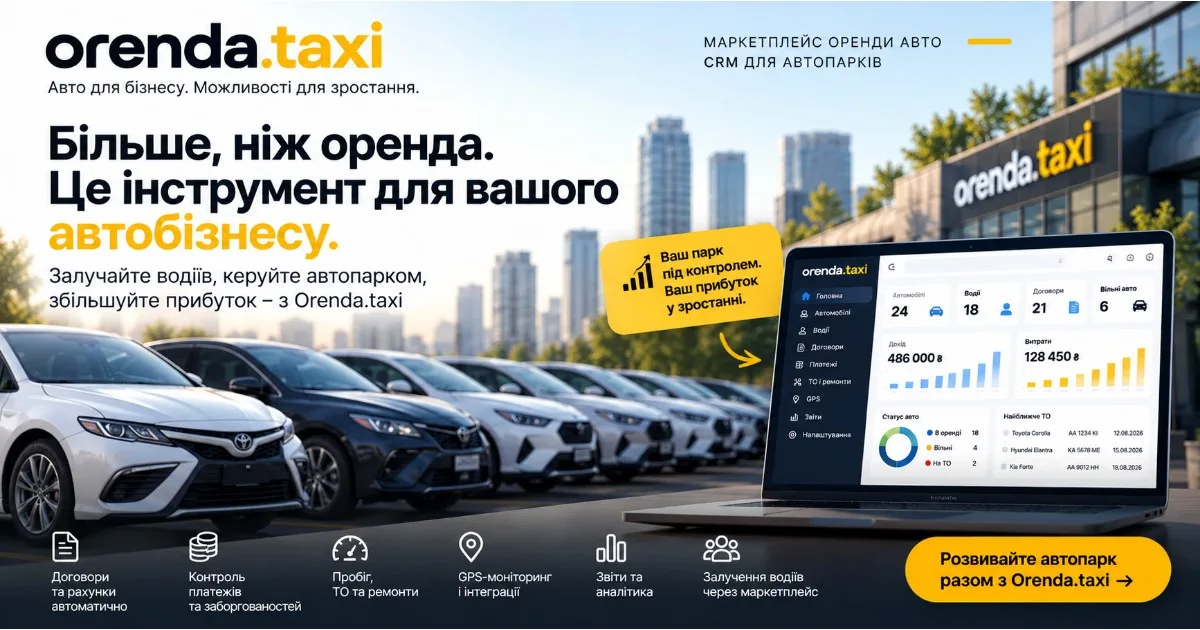
We are developing Orenda.taxi CRM specifically around these tasks. The system helps fleets manage vehicles, drivers, and contracts, monitor payments and debts, mileage, maintenance, finances, and GPS data.
Separately, the CRM is connected to the marketplace: available vehicles are automatically shown to people searching for rental cars. There is also integration with Google Ads for advertising specific available vehicles.
The idea is simple: less manual accounting → more control → faster response to downtime and issues → clearer fleet economics.
Even if the fleet today consists of just a few vehicles, accounting should be structured so that it can also be managed tomorrow with 20, 50, or more vehicles.